Investment Scenario Planning: 7 Smart Ways to Compare Outcomes
Investment scenario planning helps you compare several possible investing paths before you commit real money. Instead of trusting one projection, you test contributions, allocation, risk, fees, benchmarks and goals side by side.
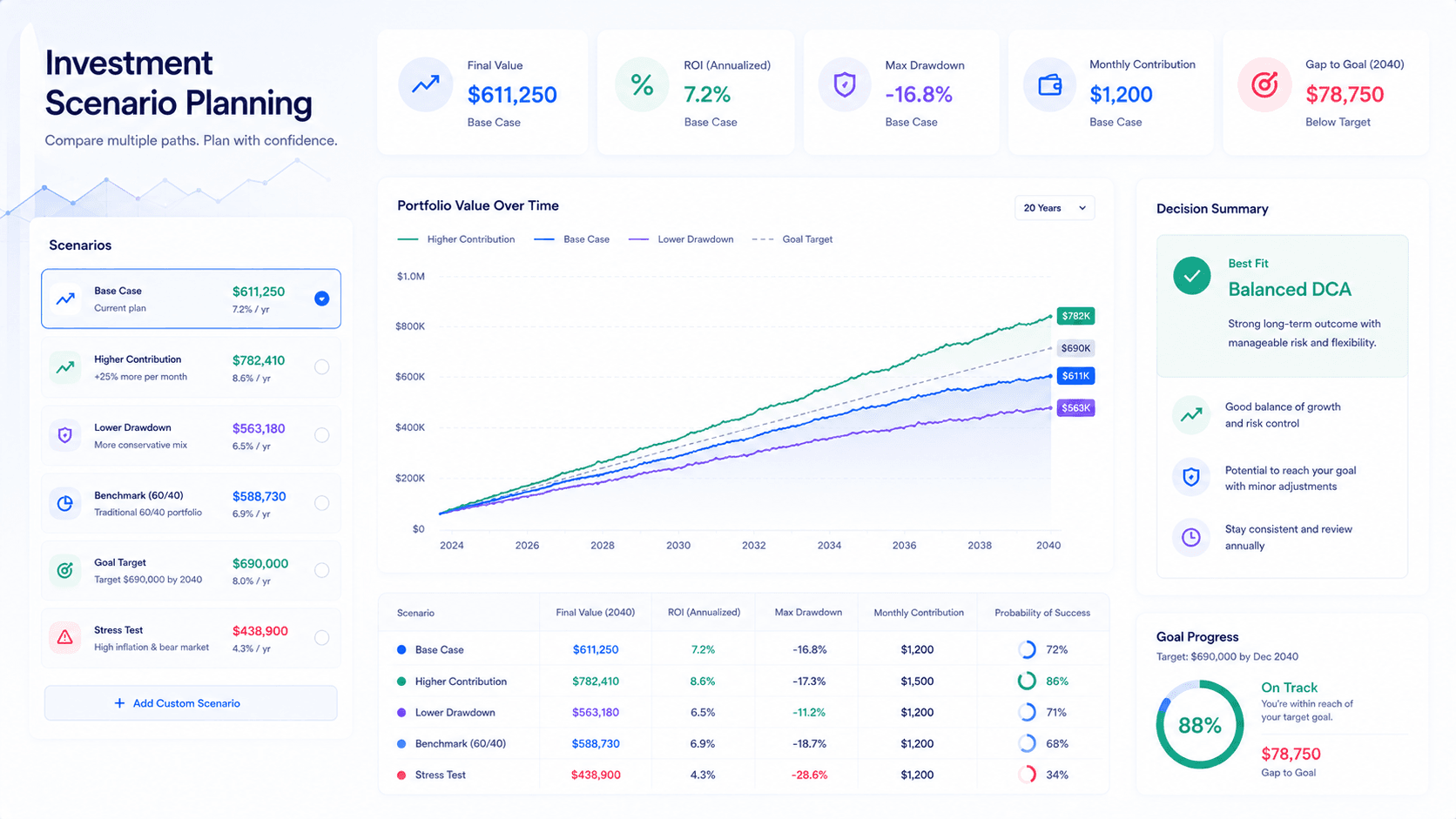
Investment scenario planning turns one assumption into a decision system
Investment scenario planning is the process of testing several possible investing paths before deciding which one deserves action. A simple calculator can show one future value. A scenario planning workflow compares the base case, the optimistic case, the conservative case, the risk case, the benchmark case and the goal case together.
That matters because most investment decisions are not only about final value. A plan can finish with a high number and still require an uncomfortable drawdown. Another plan can finish slightly lower but feel easier to follow because contributions are realistic, fees are lower and the path is smoother. Investment scenario planning makes those tradeoffs visible.
The purpose is not to predict the future. The purpose is to make assumptions explicit. Once the assumptions are visible, you can decide whether the plan needs a larger monthly contribution, a longer time horizon, a different allocation, a benchmark comparison, a fee check or a Premium workflow with saved scenarios and exportable reports.
A good scenario plan starts with a base case
The first step in investment scenario planning is to create a base case. This is not the perfect plan. It is the plan you would probably follow if you had to decide today. It includes the starting balance, monthly contribution, asset or portfolio, start date, end date, benchmark and any known fees.
Once the base case is clear, every other scenario changes one important assumption. This is the difference between useful investment scenario planning and random experimentation. If you change the contribution, asset mix, start date, benchmark and fees all at the same time, you will not know what caused the difference. Scenario planning works best when each variant answers one clear question.
Model the plan you would realistically follow today.
Change one important assumption at a time.
Review final value, ROI, drawdown, fees and benchmark gap.
Decide what needs refinement before the plan becomes real.
This is where the free Investment Simulator becomes useful. It lets you convert a vague question into a testable historical path. If the question becomes more complex, the Premium workflow becomes useful because it can compare multiple portfolios, saved scenarios, fees, withdrawals, risk metrics, benchmark insights and exportable reports.
7 smart scenarios to compare before you choose a plan
Investment scenario planning becomes practical when you know which scenarios are worth testing. You do not need dozens of random variations. You need a short set of scenarios that reveal the main tradeoffs.
This is the current plan: current contribution, current asset choice, current time horizon and realistic assumptions. It gives every other scenario a reference point.
This tests whether saving more each month improves the outcome enough to justify the lifestyle tradeoff. It is especially useful after reading a plan like budget to investment plan.
This tests the minimum viable plan. If the lower contribution still reaches a reasonable outcome, the plan may have flexibility. If it fails badly, the goal depends on disciplined funding.
This compares investing gradually with investing immediately. Use the dedicated DCA vs Lump Sum Calculator when the timing decision is central.
This compares the strategy with a simple benchmark such as SPY or a broad market ETF. It helps show whether complexity actually added value. The portfolio benchmark SPY guide explains this angle in more detail.
This tests what happens if the plan meets a difficult market period, deeper drawdown or slower recovery. Use stress test investment plan when resilience is the main concern.
This connects the scenario to a target amount and target date. For that specific workflow, use goal based investing simulation.
The inputs matter more than the output
The biggest mistake in investment scenario planning is obsessing over the final number while ignoring the inputs that created it. A final value is only as useful as the assumptions behind it. If the time horizon is unrealistic, if the monthly contribution is not affordable, if the asset mix is too concentrated or if fees are missing, the result can feel precise while still being weak. In practice, investment scenario planning is only useful when the assumptions are clear enough to challenge.
Start with inputs you can explain in plain language. Why this contribution? Why this asset? Why this start date? Why this benchmark? Why this time horizon? If you cannot explain the input, the scenario is probably not ready for comparison.
The most controllable lever. A higher contribution can matter more than chasing a slightly higher return.
Longer timelines can absorb more volatility, but they also require patience and consistency.
Allocation shapes both return potential and drawdown risk. Use portfolio allocation comparison when this is unclear.
A benchmark prevents the plan from being judged in isolation.
Small annual costs can compound into a large drag over long periods.
A plan only works if the investor can keep following it when the path gets uncomfortable.
For neutral background on asset allocation, Investor.gov explains why the mix of asset classes affects risk and return. FINRA also provides useful investor education on diversification. Those concepts are important because scenario planning is not just about selecting an asset. It is about understanding the portfolio behavior that asset creates.
Compare scenario outcomes using the same scorecard
Investment scenario planning should use the same scorecard for every scenario. If you judge one plan by final value and another plan by drawdown, the comparison becomes biased. A clean scorecard forces each scenario to answer the same questions.
| Metric | What it tells you | Decision use |
|---|---|---|
| Final value | The ending portfolio value at the end date. | Shows which plan finished highest, but not how difficult the path was. |
| Total invested | The cash added by the investor over time. | Separates market growth from personal funding effort. |
| Gain | Final value minus total invested and withdrawals. | Helps compare wealth created by the scenario. |
| ROI | Return relative to invested amount. | Useful when contribution amounts differ across scenarios. |
| Max drawdown | The largest peak-to-trough decline. | Shows the emotional and risk challenge of the path. |
| Benchmark gap | Difference versus a simple reference strategy. | Reveals whether complexity improved or weakened the plan. |
| Fees | Estimated cost drag over the period. | Helps identify whether the strategy is expensive for the value it adds. |
The Premium Simulator is valuable because it organizes those comparisons into a repeatable workspace. You can compare scenarios, save them, reload them later, export a report and review the decision again without rebuilding everything from scratch.
When drawdown becomes the key uncertainty, use the portfolio drawdown calculator workflow to isolate max drawdown, recovery time, and whether the final value was worth the path.
The best scenario is not always the highest final value
A common investment scenario planning mistake is choosing the scenario with the highest final value and ignoring everything else. That can be dangerous. The highest final value may require the largest drawdown, the most concentrated asset, the most aggressive return assumption or the least realistic contribution schedule.
Investment scenario planning should ask whether the investor can actually live with the plan. A strategy that looks great after ten years may still fail if it drops 45 percent in year two and the investor abandons it. A lower-return plan with lower drawdown can sometimes be a better fit because it is more likely to survive real behavior.
If the winner depends on one asset, one market regime or one unrealistic contribution schedule, it may be fragile. Use investment scenario planning to test whether the result survives a benchmark and stress scenario.
If a plan has slightly lower final value but lower drawdown, lower fees and more realistic contributions, it may be easier to follow. The best plan is the one that can be repeated.
This is why the WhatIfInvested framework is built around Simulate, Compare, Understand. Simulate the path. Compare the tradeoffs. Understand the decision before committing.
Scenario planning is strongest when it leads to a next action
Investment scenario planning should not end with a pretty chart. The point is to decide what to do next. After comparing the scenarios, the investor should be able to say one of five things: the plan is good enough to start, the contribution needs to increase, the timeline needs to extend, the allocation needs to change, or the risk is too high for the expected reward.
This is where many investors get stuck. They run a simulation, see a large ending value, and stop there. A better workflow asks whether the scenario changed the decision. If it did not change anything, it may have been interesting but not useful. A useful scenario makes the next step clearer.
For example, if the base case reaches 80 percent of the target but a higher contribution case reaches 96 percent, the next decision may be budget-related. The investor might use budget to investment plan to see whether the extra contribution can realistically come from monthly surplus. If the benchmark scenario performs almost as well with lower complexity, the next decision may be simplification. If the stress scenario shows a painful drawdown, the next decision may be risk reduction.
Good investment scenario planning therefore creates a decision trail. It shows what was tested, why it was tested, what changed, and what should be tested next. That decision trail is especially important when the investor comes back months later and wants to remember why a certain assumption looked reasonable.
Test a higher monthly contribution, a later target date, or a more realistic budget surplus before changing the asset mix.
Compare the current strategy against a benchmark and a diversified alternative before reaching for more risk.
Stress test the plan, review drawdown, and decide whether the investor could keep following it.
Write down the assumption behind every scenario
A scenario without a note is easy to misread later. When you create an investment scenario planning workflow, write down why each scenario exists. The note does not need to be long. It only needs to explain the decision being tested. This turns investment scenario planning into a record of decisions, not just a collection of outputs.
For example, a scenario named "Growth Portfolio" is less useful than a scenario named "Growth portfolio with $800 monthly contribution and SPY benchmark." The second version tells you what changed. It also helps avoid comparing scenarios that answer different questions.
This is one of the reasons saved scenarios matter. A serious investor may not make a decision in one sitting. They may test a base case today, revisit the contribution later, adjust the benchmark after reading new research, and export a report before discussing the plan with a spouse or advisor. If the assumptions are not saved, the planning process becomes fragile.
Investment scenario planning is also useful for reducing hindsight bias. Without saved assumptions, investors often remember only the final result. With saved assumptions, they can see what they believed before the market moved. That makes the process more honest and more repeatable.
| Scenario note | Why it helps | Example |
|---|---|---|
| Question tested | Clarifies what the scenario is supposed to answer. | Can $600/month reach the target by 2040? |
| Assumption changed | Prevents messy comparisons where everything changes at once. | Only contribution changed from $600 to $800. |
| Decision trigger | Defines what result would make the investor act. | If drawdown exceeds 35%, test a lower-risk allocation. |
| Next test | Keeps the workflow moving after the first result. | Compare against SPY benchmark and a balanced ETF allocation. |
A simple investment scenario planning example
Imagine an investor with $20,000 already invested and $600 available each month. The investor wants to know whether the plan can reach a long-term target without taking more risk than necessary. A single future-value calculator might estimate a clean ending value. That is useful, but incomplete.
A scenario planning workflow would test at least four versions. First, the base case: $600 per month into the current portfolio. Second, a higher contribution case: $800 per month. Third, a benchmark case: a broad market ETF with the same contribution schedule. Fourth, a conservative case: a more diversified allocation with lower expected volatility.
The final values might show that the aggressive portfolio wins. But the comparison may also show that the benchmark did almost as well with less complexity, or that the conservative portfolio had a much smaller drawdown. The point is not to crown one scenario immediately. The point is to understand the decision.
From there, the investor can decide what to test next. If contribution size is the main issue, use the DCA Calculator. If strategy comparison is the main issue, read compare investment strategies. If saving and reloading assumptions matters, use the workflow described in save investment scenarios.
Common mistakes in investment scenario planning
More scenarios are not always better. Start with a base case and change one assumption at a time.
A high final value can hide a path that the investor would not tolerate in real life.
Without a benchmark, it is hard to know whether the strategy actually added value.
A plan that requires unaffordable monthly contributions is not a plan. It is a wish.
Scenarios should be compared over the same period unless the timeline itself is the question.
If you cannot reload the scenario later, it becomes hard to learn from the decision.
Investment scenario planning FAQ
What is investment scenario planning?
Investment scenario planning is the process of comparing several possible investing paths before making a decision. It usually tests contribution amounts, timelines, asset choices, benchmarks, fees, drawdowns and final values.
How is investment scenario planning different from a calculator?
A basic calculator usually shows one projection. Investment scenario planning compares multiple assumptions side by side so you can understand tradeoffs, risk and decision quality.
How many investment scenarios should I compare?
Start with three to seven scenarios. A base case, higher contribution case, lower contribution case, benchmark case, stress case and goal case usually reveal the most important tradeoffs. This keeps investment scenario planning focused and prevents analysis paralysis.
Should I use historical data for scenario planning?
Historical data is useful because it shows real market paths, drawdowns and recoveries. It does not predict the future, but it helps you understand how a strategy behaved in actual market conditions.
What is the best metric for comparing investment scenarios?
There is no single best metric. Compare final value, ROI, total invested, max drawdown, fees, benchmark gap and whether the contribution plan is realistic.
When does investment scenario planning become a Premium workflow?
It becomes a Premium workflow when you need saved scenarios, multiple portfolios, benchmark comparison, fees, withdrawals, exports, notes and a repeatable decision workspace.
Can scenario planning help with DCA vs lump sum decisions?
Yes. Scenario planning can compare DCA and lump sum using the same asset, period and benchmark. This helps separate final value from drawdown and timing risk.
Which WhatIfInvested tool should I use first?
Use the free Investment Simulator first if you want to test one historical scenario. Use the DCA Calculator if contribution schedule is the main question. Use Premium when you need to compare, save and export several scenarios.
This article is for educational purposes only and is not financial advice. Historical performance does not guarantee future results. Investors should consider their own objectives, risk tolerance, taxes, fees and local rules before making investment decisions.