DCA Calculator: Plan recurring investments.
DCA Calculator users can model monthly, quarterly, semiannual or annual investing into stocks, ETFs or crypto. Estimate total contributions, portfolio value, gains and long-term growth from a consistent investing habit.
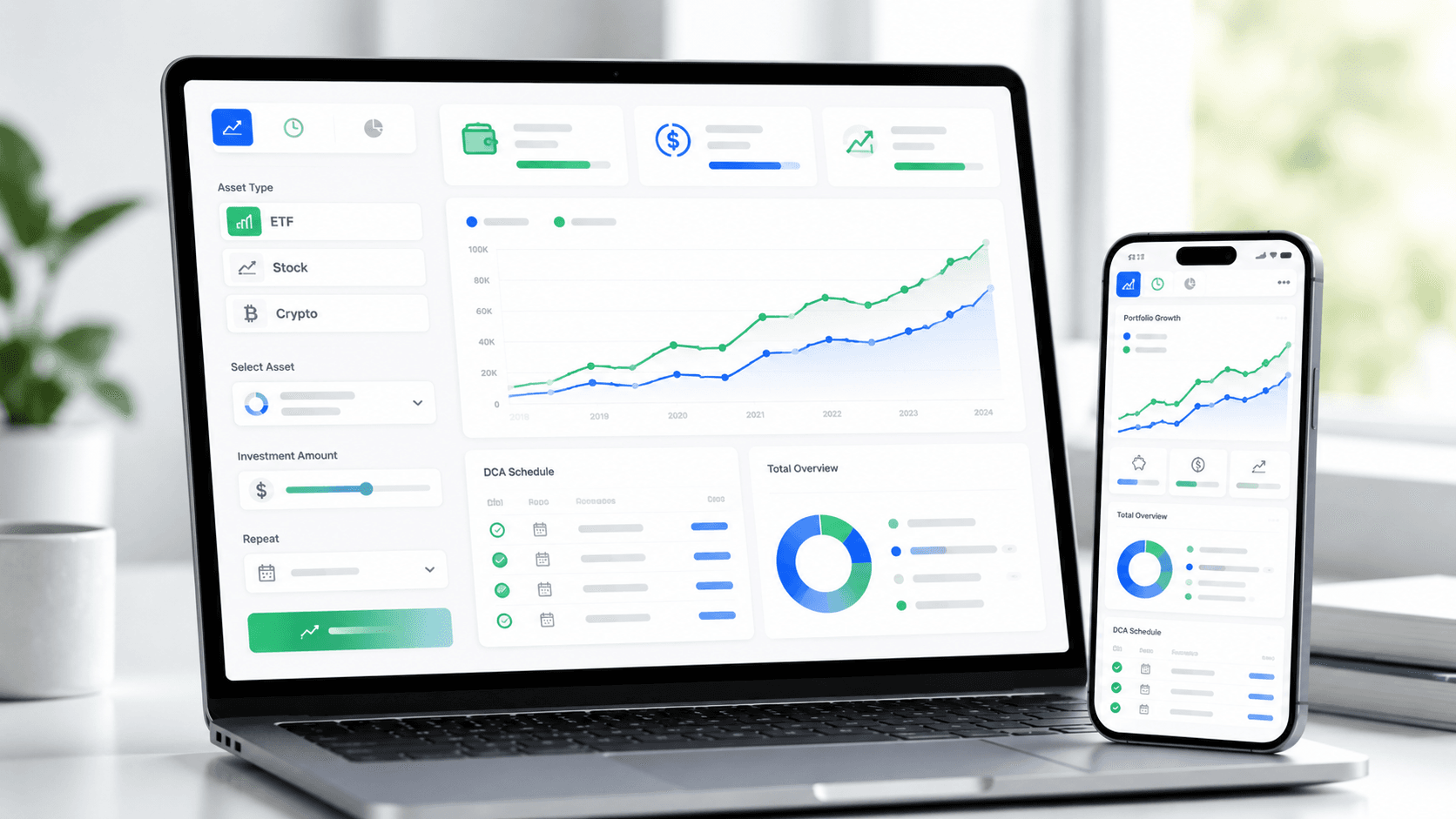
Model recurring investments over time
Choose an asset, contribution amount, date range and frequency. Results are calculated automatically from historical data when the default inputs are loaded.
Run a DCA scenario to see the ending value, total invested and gain.
The result will explain what happened and what it does not prove.
What to do after your DCA result
Your result is a starting point, not the whole decision. Use the next step that matches what you want to understand before committing real money.
Use the Investment Simulator when you want to see how the same contribution idea behaved across real market periods.
Open the simulator Compare strategies Decide between DCA and lump sum investingUse the DCA vs Lump Sum guide when you already have cash available and need a clear framework for timing risk.
Read the guide Go deeper Model portfolios, fees and benchmarks in PremiumUse Premium when a single recurring investment projection is not enough and you need a saved planning workspace.
Compare Premium plansFree DCA is enough for simple planning. Premium is for decisions that need evidence.
Use the free calculator to estimate a recurring contribution plan. Move to Premium when the decision depends on multiple portfolios, weighted assets, benchmarks, fees, rebalancing assumptions, saved scenarios or exports you can review later.
- Compare portfolios: test multiple allocation ideas side by side.
- Model assumptions: add fees, weights, benchmarks and rebalancing.
- Save and export: keep scenarios for review as your plan changes.
When the free DCA calculator is enough
The free tool should answer the first version of the question clearly. Premium should only become the next step when your investment decision has more moving parts.
Use the free calculator when
- You want one recurring contribution projection.
- You are choosing a realistic monthly, quarterly, semiannual or annual amount.
- You need a quick estimate of invested capital, growth and ROI.
- You are still defining the habit before comparing advanced strategies.
Use Premium when
- You want to compare multiple portfolio ideas side by side.
- You need weights, fees, benchmarks or rebalancing assumptions.
- You want saved scenarios or exportable reports.
- You are making a decision that needs a repeatable research workflow.
How to use the DCA calculator
Dollar-cost averaging works best when the plan is specific enough to follow automatically. Use the calculator to turn a general investing idea into a clear contribution schedule.
Choose your asset
Select the stock, ETF or crypto you want to test, then choose the period you want to model.
Set contribution details
Enter the recurring amount and frequency, such as monthly, quarterly, semiannual or annual contributions.
Review the result
Compare total invested, final value, gains and ROI to understand how consistency shaped the outcome.
Why dollar-cost averaging is useful
DCA is popular because it turns investing into a repeatable habit. Instead of waiting for the perfect entry point, you invest a fixed amount on a schedule and let time, discipline and compounding do more of the work.
This can be especially helpful for investors who receive income regularly and want to automate part of their savings. The strategy can reduce the stress of market timing because purchases are spread across different prices. It can also help investors keep buying during downturns, when emotional decision-making often becomes harder.
DCA does not guarantee better returns than lump sum investing. In rising markets, investing earlier can sometimes win. But for many real people, the behavioral benefit of staying consistent matters. That is why the best research process is to use this calculator for recurring contribution planning, then use the investment simulator to compare how different historical periods behaved. For a general investor education reference, see the SEC's Investor.gov investing basics.
Best use cases
- Plan monthly ETF, stock or crypto contributions.
- Estimate the long-term effect of increasing contributions.
- Compare contribution frequency and invested capital.
- Connect a monthly budget surplus to an investing plan.
Example: $100 per month into an ETF
If you invest $100 every month, the habit matters as much as the exact starting date. Over one year, the plan commits $1,200 of capital. Over five years, it becomes $6,000 before growth, dividends or price changes are considered.
The calculator helps you turn that habit into a measurable scenario. You can change the asset, contribution amount, frequency and date range to see how the same contribution plan behaved during different market environments.
DCA vs lump sum: which should you compare next?
DCA is often easier to follow because it matches how most people earn income: paycheck by paycheck. Lump sum investing can be stronger when markets rise after the starting date, because more capital is invested earlier. The right question is not only which strategy had the highest ending value, but which one you could realistically follow through volatility.
| Strategy | Best for | Main tradeoff |
|---|---|---|
| DCA | Investors adding money from income on a repeatable schedule. | Can reduce timing stress, but may underperform if markets rise quickly. |
| Lump sum | Investors who already have cash available and can tolerate short-term volatility. | More money is invested immediately, but the entry date matters more emotionally. |
After modeling your contribution plan here, use the investment simulator to compare DCA and lump sum across historical periods.
How to interpret your DCA results
The final portfolio value is only one part of the story. A useful DCA analysis also looks at how much money you contributed, how often purchases happened, and whether the plan stayed realistic during weak markets.
This is the amount you actually contributed. It helps separate your saving habit from market performance. If the final value is high mainly because contributions were high, the lesson may be budget discipline rather than asset selection.
DCA creates multiple purchase prices over time. The average cost helps you understand whether the strategy bought meaningfully during dips or mostly during rising periods. This is useful when comparing volatile assets.
Return on investment shows the result relative to capital deployed, but behavior decides whether the plan survives. A slightly lower return can still be valuable if the strategy is easier to repeat consistently.
For a stronger workflow, start with this calculator to define your recurring contribution plan. Then test the same idea in the investment simulator to see how different starting dates and market cycles affected the experience. Finally, use the compound interest calculator for forward-looking growth assumptions.
Continue your DCA research
These related pages create a stronger research path from recurring contributions to strategy comparison, budgeting and long-term behavior.
Frequently asked questions
Quick answers for readers who want to understand DCA before entering their own numbers.
What is dollar-cost averaging?
Dollar-cost averaging is a strategy where you invest a fixed amount at regular intervals instead of investing everything at once.
Is DCA better than lump sum investing?
Not always. Lump sum can perform better in rising markets, while DCA can reduce timing stress and make it easier to stay consistent.
Can I use this calculator for ETFs, stocks and crypto?
Yes. The calculator is designed for recurring investment scenarios across asset types when the necessary data is available.
How much should I invest each month?
Start with an amount your budget can support consistently. You can use WhatIfBudget first, then model the monthly surplus in this calculator.
What is a good DCA frequency?
Monthly investing is common because it matches many pay cycles. Quarterly, semiannual or annual schedules can also work when they fit your cash flow. The most important factor is choosing a frequency you can maintain consistently.
Should I increase my DCA amount over time?
If your income rises or your budget improves, increasing contributions can have a meaningful long-term effect. Even small increases matter because future contributions also get time to compound.
Ready to model your recurring investing plan?
Use the DCA calculator above, then compare historical outcomes with the investment simulator and future projections with the compound interest calculator.