Top ETFs for Passive Investing: 5 Core Picks for Canada and the USA
A practical Standard 4 comparison of the top ETFs for passive investing by role: U.S. core, S&P 500 core, international diversification, Canadian one-ticket equity, and bond ballast.
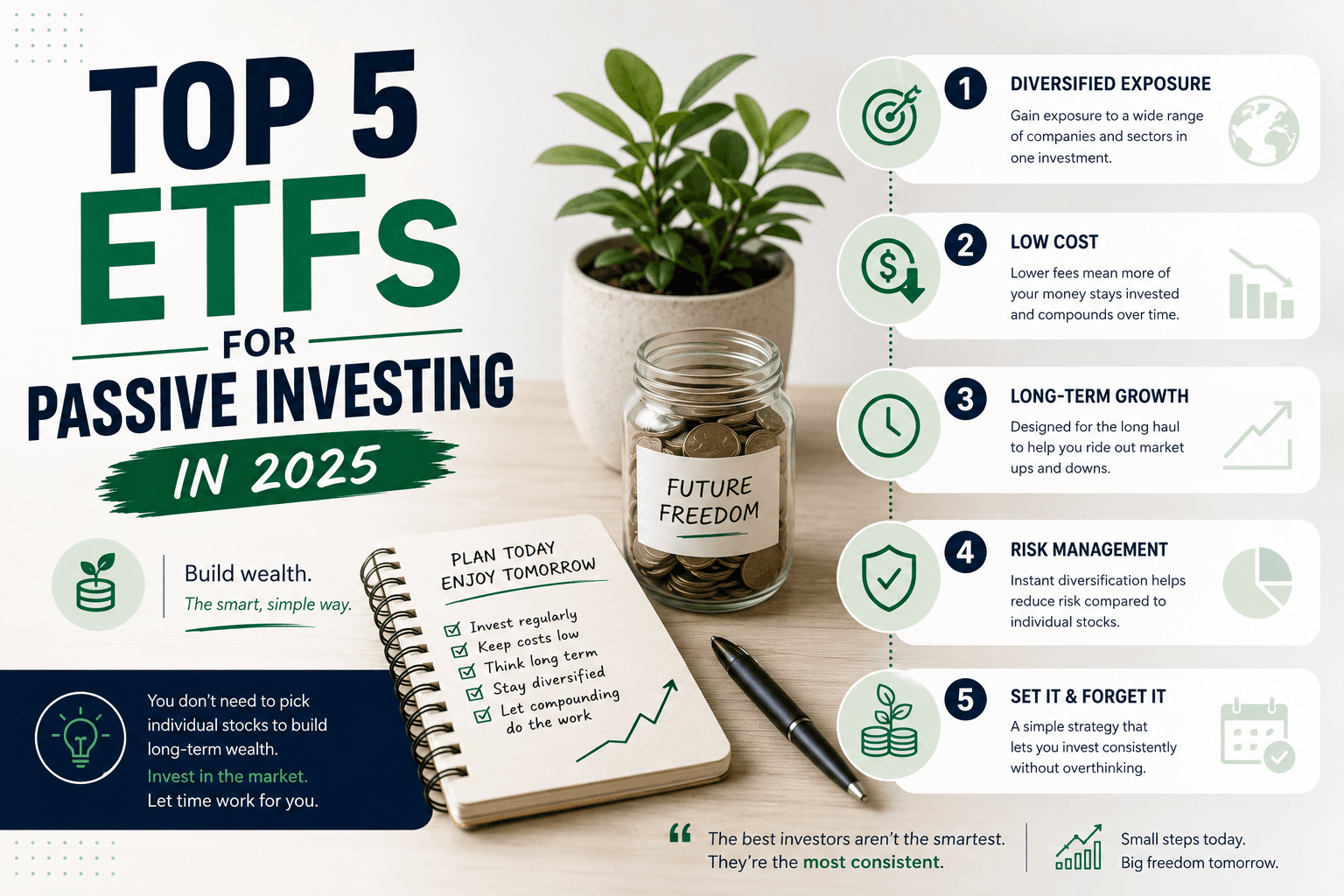
VTI or VOO can anchor a U.S. equity sleeve, depending on whether you prefer total-market or S&P 500 exposure.
XEQT can work as an all-equity one-ticket portfolio for Canadian investors who want global stock exposure in CAD.
ZAG can add Canadian bond exposure when the portfolio needs more stability than all-equity ETFs provide.
Quick Verdict: Best ETFs Depend on the Job
The best ETF is not the one with the most exciting past return. It is the one that fills the right role in your portfolio at a low cost. For passive investors, the first decision is usually not "which ticker is hottest?" It is whether you need U.S. stocks, global stocks, Canadian stocks, bonds, or a complete one-ticket solution.
For U.S.-based investors, a simple portfolio often starts with a broad U.S. ETF such as VTI or VOO, then adds international exposure with VXUS if global diversification matters. For Canadian investors, XEQT can simplify all-equity investing in Canadian dollars, while ZAG can help reduce volatility for investors who need bonds. Canadian investors using U.S.-listed ETFs should also think about account placement, currency conversion, and withholding tax.
How These Top ETFs for Passive Investing Were Selected
This refresh changes the article from a generic list into a decision matrix for the top ETFs for passive investing. The original article included several strong tickers, but it mixed core passive building blocks with more concentrated growth exposure. For a passive investing article, that distinction matters. A core ETF should help build the foundation of a portfolio, not simply chase the sector that performed best recently.
The selection rules are simple: low cost, broad diversification, clear index exposure, strong issuer support, practical use for Canadian or U.S. investors, and a role that can be explained without speculation. This is why the final five are VTI, VOO, VXUS, XEQT, and ZAG. QQQ remains useful for some investors, but it is better framed as a satellite growth tilt rather than a core passive holding.
| Selection rule | Why it matters | What to verify |
|---|---|---|
| Low fees | Fees compound against the investor every year. | Current expense ratio or MER on the issuer page. |
| Broad exposure | Passive portfolios usually benefit from diversification across many securities. | Index, holdings count, sector concentration and country exposure. |
| Clear role | Each ETF should solve a specific portfolio job. | Core U.S., international, Canadian all-equity, or bonds. |
| Liquidity and issuer strength | Large, established ETF sponsors reduce operational uncertainty. | Fund page, assets, trading volume and bid-ask spread. |
| Tax placement | The same ETF can behave differently in TFSA, RRSP, IRA, 401(k), taxable or non-registered accounts. | Tax rules for your country and account type. |
Because ETF data changes, this guide links to official fund pages wherever possible. Treat expense ratios, holdings and yields as items to verify, not permanent facts carved in stone.
Top ETFs for Passive Investing: Side-by-Side Comparison
The table below frames the top ETFs for passive investing by role. This is more useful than ranking them only by past performance, because passive investors usually need a portfolio architecture first.
| ETF | Main role | Best fit | Main caveat | Official source |
|---|---|---|---|---|
| VTI | Total U.S. stock market | U.S. core equity exposure across large, mid and small caps. | Still U.S.-only; not global diversification. | Vanguard VTI |
| VOO | S&P 500 core | Investors who want simple large-cap U.S. market exposure. | Less small-cap exposure than total-market ETFs. | Vanguard VOO |
| VXUS | International ex-U.S. stocks | U.S. investors who want non-U.S. diversification in one ETF. | Currency and regional performance can lag U.S. stocks for long periods. | Vanguard VXUS |
| XEQT | All-equity portfolio ETF | Canadian investors who want global equity exposure in one CAD-listed ETF. | 100% equity means high volatility and no bond cushion. | iShares XEQT |
| ZAG | Canadian aggregate bonds | Canadian investors who need a bond sleeve for stability. | Bond prices can fall when rates rise; not a cash substitute. | BMO ZAG |
1. VTI: Total U.S. Market Core
VTI, the Vanguard Total Stock Market ETF, is a classic passive investing building block because it gives exposure to a broad slice of the U.S. equity market. It belongs in a discussion of the top ETFs for passive investing because it can cover a large part of the U.S. stock market in one fund. Instead of only tracking the largest 500 companies, it aims to cover large, mid and small-cap U.S. stocks.
The main benefit is breadth. A total-market fund reduces the need to decide whether large caps, mid caps or small caps will lead. The investor simply owns the market. The main limitation is geographic concentration: VTI is still U.S. exposure. A globally diversified investor may still want international stocks, especially if the U.S. market becomes expensive relative to the rest of the world.
Use VTI when
- You want total U.S. equity exposure.
- You prefer one broad fund over several slices.
- You are comfortable with all-equity volatility.
Be careful when
- You already have heavy U.S. exposure elsewhere.
- You need bonds or short-term stability.
- You assume U.S. leadership will last forever.
2. VOO: Simple S&P 500 Exposure
VOO, the Vanguard S&P 500 ETF, tracks the S&P 500 and gives investors exposure to many of the largest publicly traded U.S. companies. It remains one of the top ETFs for passive investing because it is simple, highly recognizable and often used as the core U.S. stock holding in long-term portfolios.
VOO can be easier to understand for new investors because the S&P 500 is widely discussed. The tradeoff is that it excludes many smaller U.S. companies. In practice, VTI and VOO often behave similarly over many periods because large U.S. companies dominate market-cap-weighted indexes. Still, total-market investors may prefer VTI, while investors who want the cleanest large-cap benchmark may prefer VOO.
3. VXUS: International Diversification Outside the U.S.
VXUS, the Vanguard Total International Stock ETF, is useful for investors who already own U.S. stocks and want non-U.S. equity exposure in a single ETF. It can include developed and emerging markets outside the United States, which helps reduce dependence on one country.
International diversification can feel frustrating when U.S. stocks lead for long periods. That does not make it useless. Diversification is often most valuable before leadership changes, not after everyone agrees it has changed. VXUS is not a guarantee of higher returns, but it can reduce single-country concentration.
For U.S. investors, VXUS can pair naturally with VTI or VOO. For Canadian investors, a Canadian-listed all-equity ETF may be simpler if currency conversion and tax reporting are concerns.
4. XEQT: One-Ticket Global Equity for Canadian Investors
XEQT, the iShares Core Equity ETF Portfolio, is designed as an all-equity portfolio ETF. For Canadian investors, it deserves consideration among the top ETFs for passive investing because it can simplify the process of owning Canadian, U.S., international developed and emerging market stocks through a single Canadian-listed fund.
The strength of XEQT is simplicity. Instead of manually combining several ETFs, rebalancing across regions and managing multiple tickers, a Canadian investor can hold one all-equity ETF. The tradeoff is that it is still 100% stocks. It can fall sharply during market declines and may not be appropriate for investors who need stability or near-term withdrawals.
| Investor type | How XEQT may fit | What to watch |
|---|---|---|
| Young long-term investor | Simple all-equity growth portfolio. | Volatility and behavior during drawdowns. |
| Hands-off Canadian investor | One-ticket global equity exposure in CAD. | MER, underlying allocation and tax treatment. |
| Near-term goal saver | Usually too aggressive for short horizons. | Consider cash, GICs or bonds instead. |
5. ZAG: Canadian Bond Ballast
ZAG, the BMO Aggregate Bond Index ETF, gives Canadian investors exposure to a broad Canadian investment-grade bond market. It can play the role of portfolio ballast, helping reduce volatility compared with a 100% equity portfolio.
Bonds are not risk-free. When interest rates rise, bond prices can fall. A bond ETF can also fluctuate, especially if it has meaningful duration. Still, for investors who cannot tolerate all-equity drawdowns, a bond sleeve can be useful. ZAG is best understood as a stabilizer, not a return engine.
Use ZAG when
- You are Canadian and want bond exposure in CAD.
- You need a smoother portfolio than all-equity.
- You are building a balanced ETF portfolio.
Avoid overusing it when
- Your time horizon is long and you accept equity volatility.
- You need cash in the next few months.
- You expect bonds to behave like guaranteed deposits.
Where QQQ Fits: Useful, But Not a Core Passive Pick
The previous version of this article included QQQ as one of the top five ETFs. QQQ can be useful, but it is not one of the top ETFs for passive investing if the goal is a broad core portfolio. It is better treated as a concentrated growth tilt rather than a core passive holding. It tracks the Nasdaq-100, which is heavily influenced by large growth and technology-related companies.
For a passive investor, the question is not whether QQQ is a good or bad ETF. The question is whether it belongs in the core. Many investors are better served by building the core first with broad diversified ETFs, then adding a small satellite position only if they understand the extra volatility and sector concentration.
Portfolio Examples Using These ETFs
These examples are not recommendations. They show how the top ETFs for passive investing can fit together by role. The right allocation depends on risk tolerance, account type, time horizon, tax situation and country of residence.
| Investor profile | Possible structure | Why it works |
|---|---|---|
| U.S. all-equity investor | VTI plus VXUS | Combines U.S. stocks with international diversification. |
| U.S. simple S&P 500 investor | VOO plus VXUS | Keeps a familiar U.S. core while adding non-U.S. exposure. |
| Canadian hands-off equity investor | XEQT | Uses one Canadian-listed ETF for global equity exposure. |
| Canadian balanced investor | XEQT plus ZAG, or separate equity ETFs plus ZAG | Adds bond ballast to reduce equity-only volatility. |
| Growth-tilt investor | Core ETF portfolio plus small QQQ allocation | Uses QQQ as a satellite, not the foundation. |
To test how monthly contributions change the outcome, use the DCA Calculator. To backtest asset mixes and compare historical drawdowns, use the Investment Simulator.
Canada vs USA: Account Placement and Tax Caveats
Canadian and U.S. investors may use similar ETFs, but account placement can change the after-tax outcome. A Canadian investor buying U.S.-listed ETFs may face currency conversion, U.S. dividend withholding tax and different treatment in TFSA, RRSP or taxable accounts. A U.S. investor generally has simpler access to U.S.-listed ETFs but still needs to think about taxable accounts, IRAs and 401(k)s.
For Canadian investors, Canadian-listed ETFs such as XEQT and ZAG are often operationally simpler. U.S.-listed ETFs such as VTI, VOO and VXUS may still be useful, especially in larger portfolios, but they require more attention to currency and tax details. The best choice is not only about expense ratio. It is about net result after taxes, costs, currency and behavior.
Canadian investor checklist
- Confirm TFSA, RRSP and non-registered tax treatment.
- Consider currency conversion costs before using U.S.-listed ETFs.
- Use Canadian-listed one-ticket ETFs when simplicity matters.
- Verify current MER and holdings on issuer pages.
U.S. investor checklist
- Use tax-advantaged accounts when appropriate.
- Compare total U.S., S&P 500 and international exposure.
- Do not ignore international diversification just because U.S. stocks recently led.
- Keep the number of ETFs manageable.
How to Implement a Passive ETF Portfolio
After choosing the ETFs, implementation matters more than constant searching. A passive investor should decide target allocations, contribution schedule, account placement and rebalancing rule before investing. Without those rules, even good ETFs can become a messy portfolio.
- Choose a portfolio role: U.S. stocks, global stocks, Canadian stocks, bonds or satellite tilt.
- Set target weights: decide how much goes to equities, bonds and any tilt.
- Pick account placement: consider TFSA, RRSP, IRA, 401(k), taxable or non-registered accounts.
- Automate contributions: recurring deposits reduce the need for market timing.
- Rebalance periodically: review once or twice per year, or when allocations drift meaningfully.
- Document the reason: write why each ETF exists so you do not add overlapping funds later.
If you are starting small, read How to Start Investing With $50 a Month. If you want to model recurring ETF contributions, use the DCA Calculator before increasing the monthly amount.
When Not to Switch ETFs
A passive investor does not need to switch funds every time a new ETF appears with a slightly lower fee or a better recent return. Switching can create taxable events, currency conversion costs, bid-ask spread costs, tracking confusion and unnecessary behavioral activity. If your current ETF is low cost, diversified, liquid and still matches the role it was chosen for, the better decision may be to stay the course.
Changing ETFs makes more sense when the original fund no longer fits the plan: the fee becomes uncompetitive, the index changes, the portfolio has too much overlap, the account placement is inefficient, or the investor has simplified from many funds into a one-ticket solution. The decision should be based on portfolio design, not boredom.
Common ETF Mistakes to Avoid
- Owning too many overlapping ETFs: VTI and VOO overlap heavily. Owning both is not automatically wrong, but it may not add much diversification.
- Choosing by last year's winner: strong recent performance often reflects concentration, not guaranteed future return.
- Ignoring bonds until a crash: if you need stability, define the bond allocation before volatility arrives.
- Forgetting currency and tax effects: especially important for Canadians buying U.S.-listed ETFs.
- Using QQQ as a full portfolio: Nasdaq-100 exposure is concentrated and should be sized intentionally.
- Never checking official fund pages: fees, holdings, yields and methodologies can change.
Frequently Asked Questions
What are the top ETFs for passive investing?
Strong candidates depend on the investor's country and portfolio role. VTI, VOO, VXUS, XEQT and ZAG are useful examples because they cover U.S. total market, S&P 500, international stocks, Canadian all-equity exposure and Canadian bonds.
Is VTI better than VOO?
VTI is broader because it targets the total U.S. stock market, while VOO tracks the S&P 500. They can behave similarly because large U.S. companies dominate both, but VTI includes more mid and small-cap exposure.
Is XEQT a good ETF for Canadian investors?
XEQT can be useful for Canadian investors who want a simple all-equity global portfolio in one Canadian-listed ETF. It is still 100% equity, so investors should be comfortable with volatility.
Should passive investors own bonds?
It depends on risk tolerance, time horizon and income needs. All-equity portfolios can have large drawdowns. A bond ETF such as ZAG may help Canadian investors reduce volatility, but bonds are not risk-free.
Why is QQQ not in the main top five?
QQQ can be useful as a growth tilt, but it is more concentrated than broad-market passive ETFs. For a core passive portfolio, broader diversification usually deserves priority.
How often should I rebalance ETF portfolios?
Many passive investors review once or twice per year, or when allocations drift beyond a chosen threshold. The best rule is one you can follow without reacting to daily market noise.
Do ETF fees matter if they are already low?
Yes, but fees are not the only factor. Once fees are very low, diversification, tax placement, tracking quality, liquidity and behavior can matter just as much.
How can I test an ETF portfolio before investing?
Use the WhatIfInvested Investment Simulator to compare historical performance and drawdowns. Use the DCA Calculator to model recurring monthly contributions.
Official ETF Sources
ETF fees, distributions, holdings and index methodologies can change. Use issuer pages as the source of truth before investing, even when a fund appears on a list of top ETFs for passive investing.
Educational content only. This article is not investment, tax or financial advice. Verify current fund documents, tax rules and account treatment before making investment decisions.