Monthly Budget Tips for Students Living on a Low Income
A practical low-income student budget guide for rent, groceries, school costs, emergency savings, and tiny investing habits. Build a realistic plan without needing a complicated spreadsheet.
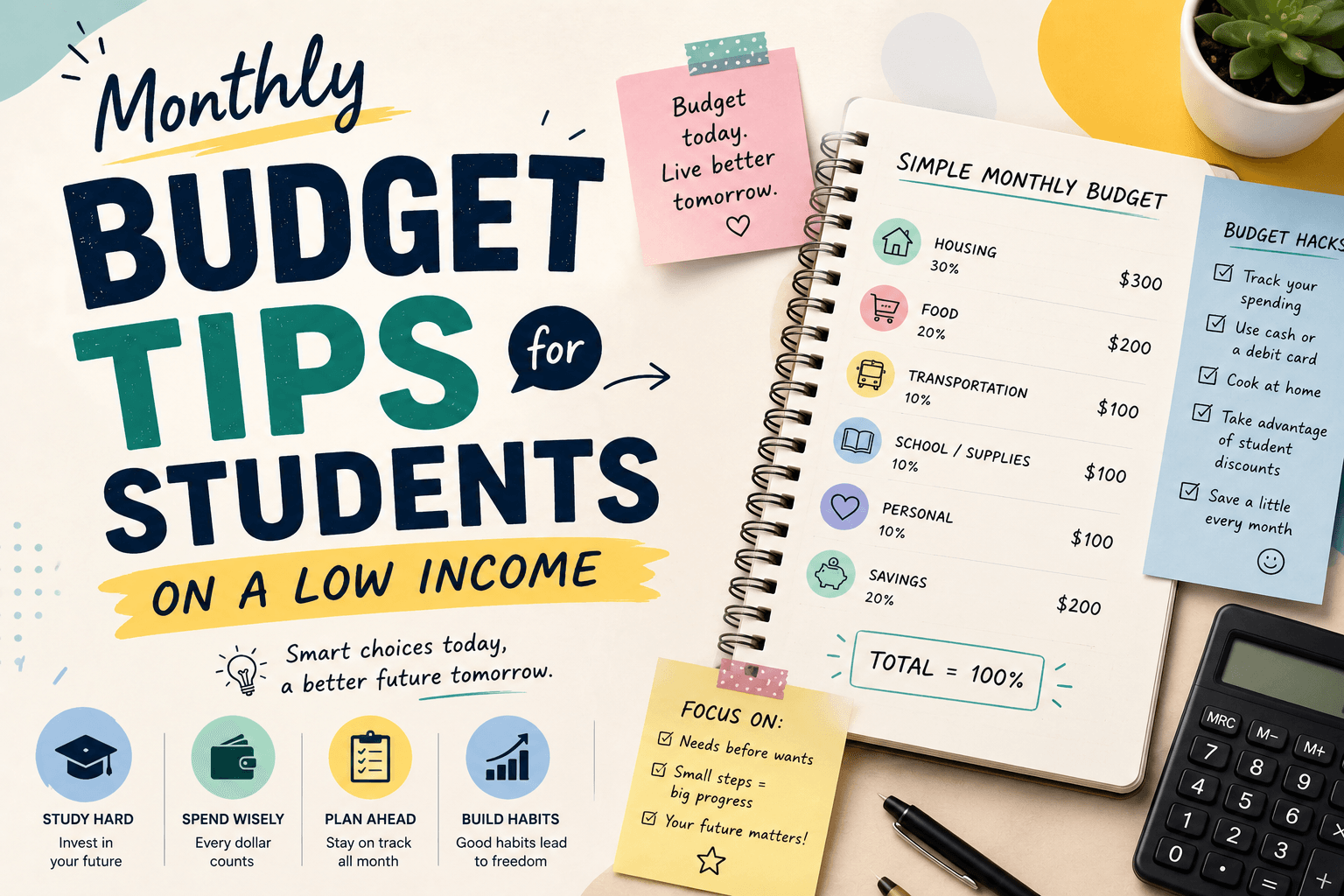
Living on a student income is difficult because your expenses are real while your income is often unstable. Rent, tuition, groceries, transport, textbooks, phone bills, and small social costs can quickly absorb every dollar. A strong student budget planner helps you decide what must be paid first, what can be reduced, and what should be saved before the month gets messy.
This guide focuses on practical monthly budget tips for students living on a low income. It is designed for students in Canada and the United States who need a simple system for essentials, irregular school costs, emergency savings, and beginner-friendly money habits. You can use it with WhatIfBudget, a spreadsheet, or a notes app.
For neutral financial education, the Consumer Financial Protection Bureau publishes youth financial education resources that support the same idea: students need simple money systems before decisions become stressful. The practical goal here is to turn that guidance into a monthly workflow you can actually repeat.
Best first move
List reliable income only. Do not build your plan around money that may not arrive.
Main goal
Protect rent, food, transport, school costs, and a small emergency buffer first.
Best method
Use zero-based budgeting so every dollar has a specific job.
Why Budgeting Matters for Students
Budgeting as a student is not about restriction. It is about survival, clarity, and fewer financial surprises. Without a plan, small transactions such as snacks, ride shares, delivery fees, coffee, and subscriptions can quietly create the end-of-month stress most students know too well.
A budget gives each dollar a role before it disappears. It helps you cover essentials, avoid late fees, prepare for textbooks and repairs, and build a small cash buffer. Even if you can only save $10, $20, or $50 a month, the habit matters because it gives you control.
Step-by-Step Student Budget Planner
1. Calculate reliable monthly income
Include after-tax wages, scholarships, grants, predictable family support, and recurring side income. If your hours vary, use the lowest of the last three months or a conservative average.
| Income source | How to estimate it | Budgeting note |
|---|---|---|
| Part-time job | After-tax pay x pay frequency | Use conservative hours |
| Scholarship or grant | Annual amount divided by 12 | Set aside some for tuition or books |
| Family support | Monthly amount you can count on | Do not include uncertain help |
| Side income | Lowest recent month | Treat extra months as bonus savings |
2. Track the last 30 days
Pull your bank and credit card transactions. Group each expense into housing, groceries, eating out, transport, school, phone, health, subscriptions, personal spending, and savings. This shows what your real habits cost before you set new targets.
3. Build a zero-based budget
Zero-based budgeting means income minus planned categories equals zero. This does not mean spending everything. It means rent, groceries, savings, debt, and future costs are all assigned before the month begins. For a deeper comparison, read Zero-Based Budgeting vs 50/30/20.
4. Add sinking funds for irregular costs
Students often forget expenses that do not happen every month: textbooks, software, dental care, travel home, laptop repairs, school supplies, and graduation fees. A sinking fund spreads those costs across the year.
5. Review weekly
Do a five-minute check each week. Update transactions, compare actual spending to your targets, and adjust wants before touching rent, food, transport, or savings.
Essential Budget Categories for Low-Income Students
The classic 50/30/20 budget rule can be useful, but students on a low income often need a modified version. Essentials may take 60% to 75% of income, especially in expensive cities.
| Category | Target range | Example on $900/month | How to reduce it |
|---|---|---|---|
| Housing | 25% to 40% | $225 to $360 | Roommates, campus housing, family housing |
| Groceries | 15% to 25% | $135 to $225 | Meal prep, student food programs, bulk basics |
| Transport | 5% to 12% | $45 to $108 | Student transit pass, bike, walking |
| School costs | 5% to 15% | $45 to $135 | Used books, library copies, rentals |
| Savings buffer | 3% to 10% | $27 to $90 | Automate on payday, start tiny |
| Wants | 10% to 20% | $90 to $180 | Cap dining out, subscriptions, convenience buys |
Best Tools and Apps for Student Budgeting
The best budgeting tool is the one you will actually open. Students usually need something fast, mobile-friendly, and private. Start simple, then add automation if you need it.
WhatIfBudget
Use WhatIfBudget for a quick monthly plan with no login required.
Expense tracking
Use this guide to track expenses automatically without Excel.
Monthly setup
Use How to Make a Monthly Budget for a broader setup process.
Money-Saving Tips for Students on a Tight Budget
Food
Plan 8 to 10 cheap meals, cook in batches, carry snacks, and use student food programs before delivery apps.
Textbooks
Buy used, rent, share, use the library, or wait until the professor confirms the book is truly required.
Subscriptions
Cancel anything unused. Rotate streaming services monthly instead of keeping several active.
Small savings are not small when your income is low. Saving $25 per week creates about $1,300 per year. That can cover books, an emergency fund, or part of tuition.
How to Budget Around the Semester Cycle
A student budget is not the same every month. September, January, and the start of summer often carry extra pressure because tuition deadlines, books, course materials, moving costs, work-hour changes, and transportation changes can arrive at the same time. A good low-income student budget should separate normal monthly expenses from semester-specific expenses.
The easiest way to handle this is to create a small semester fund. Instead of waiting for textbook week or exam travel to create stress, estimate the next four months and divide the expected irregular costs by the number of pay periods left. This turns a $300 book surprise into a planned $75 monthly category. The numbers may still feel tight, but the expense stops being invisible.
| Semester expense | When it appears | Budget move |
|---|---|---|
| Textbooks and software | Start of term | Estimate early, buy used where possible, and save monthly. |
| Transit pass or parking | Monthly or term start | Compare student pass, biking, carpool, and campus shuttle options. |
| Moving or housing deposits | Before lease changes | Keep this outside normal spending so rent money is not touched. |
| Travel home | Breaks and holidays | Book early and set a separate travel envelope. |
This semester view also helps you avoid fake surplus. If your bank account shows $200 left but you know $180 of books are coming next week, that money is already spoken for. The plan is working when it makes future pressure visible before you spend the cash.
How to Build Credit and Save While Studying
If you use a student credit card, keep it boring. Use it for one predictable bill, pay it in full every month, and keep utilization below 30% of the limit. Never carry a balance just to “build credit.” Interest costs are not worth it.
At the same time, build a small emergency fund before investing. A $300 to $500 student emergency buffer can prevent credit card debt when textbooks, travel, medication, or repairs surprise you. For a deeper target, use the Emergency Fund Calculator.
When Students Should Start Investing
Investing is useful, but only after the basics are stable. If you have high-interest debt, unpaid bills, or no emergency buffer, fix those first. Once you have a small cushion, even $10 to $25 per month can help you learn the habit.
Use the DCA Calculator to model small recurring investments, or the Investment Simulator to see long-term scenarios. If you want a beginner example, read How to Start Investing With $50 a Month.
Real-Life Student Budget Example
Here is a realistic example for a student with $900 per month in reliable income. The exact numbers will change, but the structure is the important part.
| Category | Amount | Reason |
|---|---|---|
| Rent or housing share | $330 | Largest fixed essential |
| Groceries | $180 | Meal prep heavy |
| Transport | $75 | Transit pass or fuel |
| Phone and internet | $65 | Shared or student plan |
| School sinking fund | $60 | Books, printing, supplies |
| Emergency buffer | $50 | Starter cash reserve |
| Health and personal | $60 | Medication, toiletries, basics |
| Wants | $80 | Social spending with a limit |
This is a zero-based budget because the full $900 is assigned. If extra income arrives, send part to the emergency fund, part to school costs, and part to a small reward so the plan stays sustainable.
What to Do When Student Income Changes Every Month
Many students do not earn the same amount every month. Work hours can drop during exams, increase during summer, or disappear when a class schedule changes. If your income moves around, do not build the budget from your best month. Build the budget from your safe month.
Use a baseline income number that you are highly likely to receive. Essentials should fit inside that number. When income is higher, assign the extra money in a fixed order: overdue bills first, emergency fund second, semester fund third, debt fourth, and optional spending last. This prevents a strong work month from turning into lifestyle creep.
This matters because low-income budgeting is mostly about reducing the number of emergencies. A student who smooths income across the semester has more control than a student who feels rich for one week and short two weeks later.
Recommended Next Steps
Once this student budget is in place, connect it to your broader money plan. These related guides help build the cluster naturally:
FAQ: Student Budget Planner
Is it possible to save money as a student with low income?
Yes. Start with a very small target, such as $10 to $50 per month. The goal is to build the habit and create a starter emergency buffer before trying bigger goals.
What is the best budgeting method for students?
Zero-based budgeting is often best for low-income students because every dollar is assigned to rent, food, transport, school costs, savings, or wants. If you prefer broad targets, use a modified 50/30/20 rule.
How much should students spend on housing?
Many students aim for 25% to 40% of monthly income, but this depends heavily on city and living situation. Roommates, family housing, or campus housing can reduce pressure.
Should students invest while in school?
Only after essentials, bills, high-interest debt, and a small emergency fund are handled. Then small monthly investing can be useful for learning and long-term consistency.
What tool can I use to create a student budget?
You can use WhatIfBudget for a quick no-login budget, then use related calculators once your monthly surplus becomes consistent.
This content is educational and does not replace personalized financial advice. Budget targets should be adjusted to your city, tuition, income, and personal responsibilities.