SPY vs QQQ: Which ETF Fits Your Portfolio Better?
SPY and QQQ are two of the most popular ETFs in the world, but they are not interchangeable. One is a broad S&P 500 benchmark. The other is a Nasdaq-100 growth engine. This guide compares performance, risk, holdings, fees, DCA behavior, and portfolio use cases.
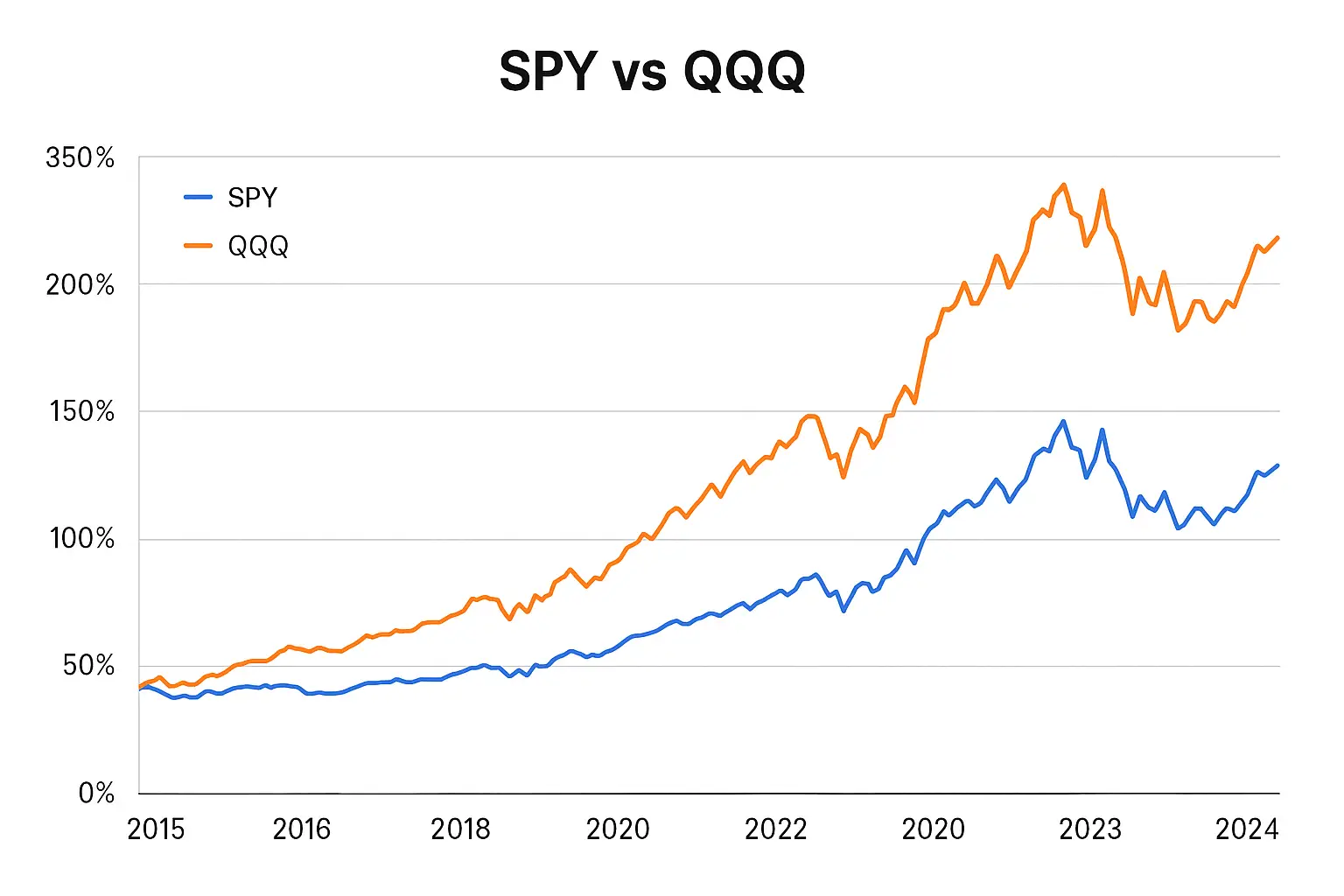
Quick answer: SPY vs QQQ
If you want the simplest answer, SPY is usually the better core ETF for broad market exposure, while QQQ is usually the better satellite ETF for investors who want a stronger growth and technology tilt. QQQ has historically offered more upside in many growth-led periods, but it also tends to come with higher concentration risk and deeper emotional swings.
That means the real question is not “Which ETF is best?” The better question is: “Which ETF fits the job I need inside my portfolio?” SPY is built around the S&P 500, which includes roughly 500 large U.S. companies across many sectors. QQQ tracks the Nasdaq-100, which is more concentrated in technology and growth-oriented companies.
Practical takeaway: many investors use SPY or another S&P 500 ETF as the core, then add QQQ as a smaller growth tilt. You can test your own allocation with the Investment Simulator or model recurring contributions with the DCA Calculator.
What are SPY and QQQ?
SPY is the SPDR S&P 500 ETF Trust. It tracks the S&P 500 index, one of the most widely followed benchmarks for large-cap U.S. stocks. Investors use SPY as a proxy for the U.S. stock market because it includes companies across technology, healthcare, financials, consumer staples, industrials, energy, communication services, and other sectors.
QQQ is the Invesco QQQ Trust. It tracks the Nasdaq-100 index, which includes 100 of the largest non-financial companies listed on the Nasdaq exchange. Because many of those companies are technology or technology-adjacent businesses, QQQ usually has a much stronger growth profile than SPY.
SPY S&P 500
SPY is broad, diversified, and commonly used as a core U.S. equity holding. It is better suited for investors who want exposure to large U.S. companies without making an aggressive sector bet.
- Tracks the S&P 500
- Broader sector diversification
- Common core portfolio building block
- Often easier to hold through downturns
QQQ Nasdaq-100
QQQ is more concentrated in innovative growth companies. It can deliver stronger upside when growth stocks lead, but it can also fall harder when valuations compress.
- Tracks the Nasdaq-100
- Higher technology and growth exposure
- Often stronger in growth-led bull markets
- Higher concentration and valuation risk
Official ETF sources for SPY and QQQ
Before making a decision, check the current fund information from the issuers. State Street publishes the official SPY ETF fund page, while Invesco publishes the official Invesco QQQ fund page. Those pages are the better place to confirm current holdings, expense ratios, distributions, and fund documents.
This SPY vs QQQ guide is meant to help you interpret the decision. Use the issuer pages for live fund facts, then use WhatIfInvested tools to compare historical scenarios, DCA behavior, drawdowns, and portfolio role.
SPY vs QQQ holdings and sector exposure
The biggest difference between SPY and QQQ is not the ticker symbol. It is the underlying exposure. SPY gives you a broad slice of large U.S. companies. QQQ gives you a more concentrated exposure to Nasdaq-listed growth leaders. This difference affects performance, risk, valuation sensitivity, and investor behavior.
SPY includes more sectors and tends to be less dependent on one group of companies. QQQ can be more dependent on a handful of mega-cap technology names. When those companies do well, QQQ can outperform dramatically. When they struggle, QQQ can underperform quickly.
| Category | SPY | QQQ | Investor implication |
|---|---|---|---|
| Index tracked | S&P 500 | Nasdaq-100 | SPY is broader; QQQ is more growth-focused. |
| Number of holdings | About 500 large U.S. companies | About 100 Nasdaq-listed non-financial companies | QQQ is more concentrated. |
| Sector profile | Diversified across many sectors | Heavy technology and growth tilt | QQQ can move more with tech sentiment. |
| Typical role | Core U.S. equity exposure | Growth satellite or aggressive core | SPY is usually more balanced. |
| Behavior risk | Moderate for equity investors | Higher due to sharper swings | QQQ requires more discipline. |
Neither ETF is automatically “better.” If your portfolio already has a lot of technology exposure, adding QQQ may increase concentration more than you realize. If your portfolio is too defensive and you want a growth tilt, QQQ may be useful. If you want one simple U.S. equity position, SPY is usually the cleaner benchmark.
SPY vs QQQ fees, liquidity, and tax considerations
Fees are not the main reason most investors choose between SPY and QQQ, but they still matter. Both ETFs are large, liquid, and widely traded. For long-term investors, the more important cost is usually not just the expense ratio. It is the combination of fund fee, bid-ask spread, trading behavior, tax treatment, and whether the ETF encourages you to trade too often.
SPY is one of the most liquid ETFs in the world and is heavily used by traders, institutions, and long-term investors. QQQ is also highly liquid and popular, especially among investors who want Nasdaq-100 exposure. In normal market conditions, both are generally easy to buy and sell through major brokerages. Still, investors should avoid making frequent changes just because the ETFs are liquid. Liquidity makes trading easy, but it does not make overtrading smart.
| Cost area | Why it matters | Practical takeaway |
|---|---|---|
| Expense ratio | The annual fund cost reduces returns slightly over time. | Compare fees, but do not let a tiny fee difference outweigh portfolio fit. |
| Bid-ask spread | The hidden cost between buying and selling prices. | Use limit orders if spreads widen, especially during volatile markets. |
| Trading frequency | Frequent switching can create taxes, stress, and poor timing decisions. | A boring plan often beats constant optimization. |
| Account type | Taxable, retirement, and registered accounts can treat gains and distributions differently. | Use the right account for your situation and get tax advice when needed. |
For Canadian investors, the decision may also involve currency conversion, U.S.-listed ETFs versus Canadian-listed alternatives, and account type. For example, a Canadian investor may compare U.S.-listed ETFs with Canadian equivalents depending on brokerage fees, currency strategy, withholding tax considerations, and whether they prefer simplicity. This is why a pure SPY vs QQQ performance chart is not always enough. The best ETF on a chart may not be the most convenient ETF inside your real account.
For U.S. investors, the discussion is usually simpler because SPY and QQQ trade directly in U.S. dollars. Even then, taxes can matter in a taxable brokerage account. Selling one ETF to chase another can create realized gains. Rebalancing too often can also create tax events. That does not mean you should avoid rebalancing forever, but it does mean your investment plan should define when changes are worth making.
Practical answer: SPY vs QQQ is not only about historical performance. A strong comparison also includes fees, liquidity, taxes, account type, currency, rebalancing rules, and whether the ETF helps you behave consistently.
SPY vs QQQ performance: why the winner changes by period
QQQ has often delivered stronger long-term returns during periods when large-cap technology and growth stocks led the market. That is not surprising. Its index is built with more exposure to companies that benefited from cloud computing, digital advertising, semiconductors, software, e-commerce, artificial intelligence, and platform businesses.
But performance leadership is not permanent. Growth stocks can experience long stretches of underperformance when valuations are high, interest rates rise, earnings disappoint, or investors rotate into value, dividends, energy, financials, or defensive sectors. SPY may lag during powerful tech cycles, but its broader sector exposure can help reduce dependence on one theme.
QQQ tends to win when
Growth stocks lead, tech earnings are strong, interest rate pressure is low, and investors reward innovation-heavy companies.
SPY tends to hold up when
Market leadership broadens, defensive sectors matter, value stocks recover, or technology valuations compress.
The real test
Do not only compare ending value. Compare volatility, drawdown, recovery time, and whether you could stay invested.
Why QQQ can outperform
QQQ is structurally tilted toward growth. If the largest innovative companies keep expanding earnings faster than the broader market, QQQ can compound at a higher rate. Investors who believe technology will remain the dominant driver of productivity, margins, and market leadership may prefer a higher QQQ allocation.
Why SPY can be more durable
SPY does not need one sector to dominate forever. It owns a broader set of companies and sectors, which can make the investment experience smoother. In long-term investing, smoother does not mean risk-free. SPY can still suffer major drawdowns. But compared with a concentrated growth ETF, it may be easier for many investors to hold through uncertainty.
Risk comparison: volatility, drawdowns, and concentration
The most common mistake in SPY vs QQQ comparisons is focusing only on return. Return is only half the story. The other half is what the investor had to live through to get that return. QQQ may offer higher upside, but it can also have sharper declines. SPY may offer lower upside during growth-led markets, but its diversification can reduce concentration risk.
| Risk factor | SPY | QQQ | What to watch |
|---|---|---|---|
| Volatility | Equity volatility, but more diversified | Usually higher due to growth concentration | Can you keep buying during a sharp decline? |
| Drawdown risk | Can still fall significantly | Can fall harder in tech-led selloffs | Compare max drawdown and recovery time. |
| Concentration | Lower single-theme dependence | More dependent on mega-cap growth | Check overlap with your other holdings. |
| Valuation sensitivity | Moderate | Higher | Growth stocks can be sensitive to interest rates. |
Risk tolerance is not what you say during a bull market. It is what you do during a drawdown. If a QQQ-heavy portfolio would make you stop investing, sell at the wrong time, or abandon your plan, then QQQ may be too large in your portfolio even if the long-term chart looks attractive.
SPY vs QQQ for dollar-cost averaging
Both SPY and QQQ can work well with dollar-cost averaging. The difference is how the DCA journey feels. DCA into SPY usually gives broad market exposure with less concentration. DCA into QQQ gives more growth exposure and can produce stronger long-term upside when growth stocks lead, but it may also require more emotional discipline.
DCA can be especially useful for QQQ because it reduces the pressure of choosing the perfect entry point. Instead of investing everything before a possible tech correction, you spread contributions across different price levels. This does not guarantee better returns, but it can make the strategy easier to follow.
DCA into SPY
Best for investors who want broad market exposure, simple behavior, and long-term compounding without a strong sector bet.
DCA into QQQ
Best for investors who accept higher volatility and want recurring exposure to growth-heavy Nasdaq companies.
DCA into both
Best for investors who want a broad market core with an intentional growth tilt layered on top.
For a practical comparison, model your own monthly contribution in the DCA Calculator. If you want to test historical entry points, use the Investment Simulator. For deeper portfolio comparisons with saved scenarios and exports, compare Premium plans.
SPY vs QQQ allocation examples
Allocation is where the comparison becomes practical. Many investors do not need a binary answer. They need a realistic mix. A portfolio can be 100% SPY, 100% QQQ, or a combination. The right mix depends on whether you want broad exposure, aggressive growth, or a balanced approach that still tilts toward innovation.
The most common structure is core and satellite. SPY plays the core role because it provides broad U.S. large-cap exposure. QQQ plays the satellite role because it increases exposure to Nasdaq growth leaders. This keeps the portfolio from becoming completely dependent on technology while still allowing the investor to benefit if growth companies continue to lead.
Conservative equity tilt
90% SPY / 10% QQQ. This keeps SPY as the clear core while adding a small growth tilt. It may fit investors who want a little extra Nasdaq exposure without changing the character of the whole portfolio.
Balanced growth tilt
80% SPY / 20% QQQ. This is a common middle ground for investors who want a meaningful growth sleeve but still want the S&P 500 to anchor the portfolio.
Aggressive growth tilt
60% SPY / 40% QQQ. This increases upside potential but also raises concentration risk. It usually fits long time horizons and investors who can tolerate deeper swings.
How rebalancing changes the result
Rebalancing is often ignored in ETF comparisons. Suppose you choose an 80/20 SPY and QQQ portfolio. If QQQ outperforms for several years, it may grow from 20% of the portfolio to a much larger share. That can be good for returns, but it also increases risk. Rebalancing brings the portfolio back toward the original plan.
There are two common approaches. Calendar rebalancing means you review the portfolio on a set schedule, such as quarterly or annually. Threshold rebalancing means you rebalance only when an allocation drifts beyond a specific band. The right method depends on tax sensitivity, brokerage costs, and how much drift you are willing to accept.
For investors making monthly contributions, new deposits can rebalance the portfolio without selling. If QQQ has grown too large, you can direct new contributions toward SPY until the allocation returns closer to target. This can be more tax-efficient than selling appreciated shares in a taxable account.
How to use SPY and QQQ in a real portfolio
Most investors do not need to choose only one. A portfolio can use SPY as a core holding and QQQ as a satellite tilt. This approach keeps the portfolio anchored to broad U.S. equities while still allowing extra exposure to growth companies. The right allocation depends on risk tolerance, time horizon, income stability, and whether the investor already owns technology-heavy funds elsewhere.
| Portfolio style | Possible allocation | Who it may fit |
|---|---|---|
| Simple core | 100% SPY or broad market equivalent | Investors who want simplicity and broad exposure. |
| Core plus growth tilt | 80% SPY / 20% QQQ | Investors who want growth exposure without making QQQ the entire portfolio. |
| Aggressive growth | 50% SPY / 50% QQQ or higher QQQ tilt | Long-term investors with high risk tolerance and stable cash flow. |
| Diversified global | SPY or QQQ plus international and bonds | Investors who want less dependence on U.S. large-cap growth. |
The mistake is not owning QQQ. The mistake is owning QQQ accidentally because your portfolio already has similar exposure through other ETFs. Many investors hold SPY, QQQ, growth funds, technology funds, and individual mega-cap technology stocks at the same time. That can create more concentration than expected.
Portfolio check: if your holdings overlap heavily, use a simulator or spreadsheet to estimate your real exposure. If you are building with recurring contributions, read S&P 500 DCA, SPY vs VOO, and Top ETFs for Monthly DCA Contributions.
A simple decision framework for SPY vs QQQ
If you are still unsure, use a decision framework instead of trying to predict the next winning ETF. Forecasting which index will outperform next year is difficult. But identifying your own needs is much easier. The ETF that fits your investment behavior is often better than the ETF that looks best on a recent chart.
| Question | If your answer is yes | Likely direction |
|---|---|---|
| Do you want one simple U.S. equity ETF? | You prefer broad exposure and fewer decisions. | SPY or a broad market equivalent. |
| Do you believe growth and technology should be overweight? | You accept more concentration for higher upside potential. | Add QQQ as a satellite tilt. |
| Would a major tech drawdown make you stop investing? | Your behavior risk is more important than theoretical upside. | Keep QQQ smaller or avoid it. |
| Are you already exposed to mega-cap tech elsewhere? | Your portfolio may already be growth-heavy. | Review overlap before adding QQQ. |
| Do you contribute every month? | DCA can help you handle volatility and rebalance with deposits. | Test SPY, QQQ, and blended allocations. |
Best answer by investor type
Beginner investors usually benefit from starting broad. SPY or a total market ETF keeps the first decision simple and reduces the chance of overreacting to sector-specific volatility. Once the investor understands diversification, risk, and overlap, a QQQ tilt can be added intentionally.
Growth-focused investors may prefer QQQ or a blended allocation. But they should define the maximum percentage they are comfortable holding. A growth tilt is useful only if the investor can hold it through drawdowns and keep contributing when headlines are negative.
Retirement-focused investors may prefer SPY as part of a broader allocation that includes bonds, cash, international exposure, or lower-volatility assets. QQQ can still have a role, but the size should reflect withdrawal needs, timeline, and sequence-of-returns risk.
DIY portfolio builders should compare SPY and QQQ inside the full portfolio, not in isolation. The best ETF may change once you include other holdings, contribution schedule, taxes, and planned withdrawals. This is where a simulator becomes more useful than a generic article.
Common mistakes when comparing SPY and QQQ
SPY vs QQQ is a simple comparison on the surface, but investors often make mistakes that lead to poor conclusions. The most common problem is choosing the ETF with the best recent return without understanding what caused that return.
1. Chasing the recent winner
If QQQ outperformed recently, it is tempting to assume it will always outperform. But market leadership rotates. Growth stocks can dominate for years and then struggle. A good decision should be based on portfolio role, not only recent performance.
2. Ignoring overlap
SPY already owns many of the same mega-cap companies that drive QQQ. Adding QQQ does not add entirely new exposure. It increases the weight of a similar group of companies. That can be good if intentional, but risky if accidental.
3. Comparing return without drawdown
A higher final value is attractive, but the path matters. If the strategy would have made you panic during a decline, the theoretical return may not be achievable in real life.
4. Forgetting your time horizon
QQQ may fit a long-term investor with decades ahead. It may be too aggressive for someone who needs money soon. The closer you are to using the money, the more drawdown risk matters.
5. Treating ETF choice as the entire plan
Your savings rate, contribution consistency, emergency fund, debt level, and ability to stay invested often matter more than choosing between two good ETFs. A strong plan combines asset selection with behavior and cash flow discipline.
6. Forgetting the role of cash flow
A monthly investor and a lump sum investor may experience SPY vs QQQ very differently. If you are contributing every month, volatility can create opportunities to buy at lower prices. If you invest one large amount at once, the entry point may matter more emotionally. This is why comparing only a single start date can be misleading.
7. Assuming concentration is always bad
Concentration is not automatically bad. It is a tool. QQQ is more concentrated than SPY, and that concentration can help when its largest sectors perform well. The problem is unmanaged concentration. If you choose QQQ knowingly, size it intentionally, and understand the downside, it can be part of a thoughtful portfolio.
8. Not writing down the reason for the choice
Before buying either ETF, write a one-sentence reason. For example: “SPY is my core U.S. equity position because I want broad exposure,” or “QQQ is my 20% growth tilt because I want more Nasdaq exposure.” That simple note can stop you from changing strategy every time the market narrative changes.
Test SPY vs QQQ with your own numbers
The most useful SPY vs QQQ comparison is not generic. It is your own scenario: your starting amount, your monthly contribution, your time horizon, your risk tolerance, and your preferred allocation. A 25-year-old investor contributing every month may reach a different conclusion than a 60-year-old investor protecting capital.
Investment Simulator
Backtest SPY, QQQ, DCA, lump sum, and historical investment scenarios.
DCA Calculator
Model recurring contributions and long-term portfolio growth.
Premium plans
Compare weighted portfolios, fees, rebalancing, withdrawals, and saved scenarios.
Frequently asked questions
Is SPY or QQQ better for long-term investing?
SPY is usually better as a broad core holding because it tracks the S&P 500 and includes more sectors. QQQ may be better for investors who want a stronger growth tilt and can tolerate higher volatility.
Is QQQ riskier than SPY?
Yes, QQQ is generally more concentrated and more growth-oriented than SPY. That can create stronger upside during technology-led markets, but it can also create sharper drawdowns when growth stocks fall.
Can I hold both SPY and QQQ?
Yes. Many investors use SPY as the core and QQQ as a satellite growth tilt. The key is to understand overlap and avoid accidentally concentrating too much in the same mega-cap technology companies.
Which ETF is better for DCA?
Both can work for DCA. SPY may be easier for conservative long-term investors because it is broader. QQQ may offer more growth potential but requires more tolerance for volatility.
Should beginners choose SPY or QQQ?
Beginners often do better starting with a broad ETF like SPY or a total market equivalent. QQQ can be added later as a deliberate growth tilt once the investor understands concentration risk.
What is the best way to compare SPY vs QQQ?
Compare total return, drawdown, recovery time, volatility, sector exposure, fees, and fit with your portfolio. Do not rely only on recent performance.
What allocation between SPY and QQQ makes sense?
There is no universal allocation. A conservative investor might use mostly SPY with a small QQQ tilt. A growth investor might use a larger QQQ allocation. The key is to choose a mix that matches your risk tolerance, time horizon, and existing holdings.
Is SPY vs QQQ enough diversification?
SPY and QQQ both focus on large U.S. companies, and they overlap in several major holdings. Some investors may also want international stocks, bonds, cash, or other assets depending on their goals and risk profile.
Final verdict: SPY vs QQQ
SPY and QQQ are both strong ETFs, but they solve different problems. SPY is the cleaner broad-market core. QQQ is the more aggressive growth tilt. If you want a simple long-term portfolio, SPY is often easier to justify as the foundation. If you believe in long-term technology and growth leadership and can handle deeper swings, QQQ can be a powerful addition.
The best choice is the one you can hold and keep funding through market stress. A portfolio that looks perfect on paper but causes panic during drawdowns is not the right portfolio. Use SPY for broad exposure, use QQQ intentionally for growth exposure, and test your own allocation before committing.
Educational simulation only. Historical performance does not guarantee future results.